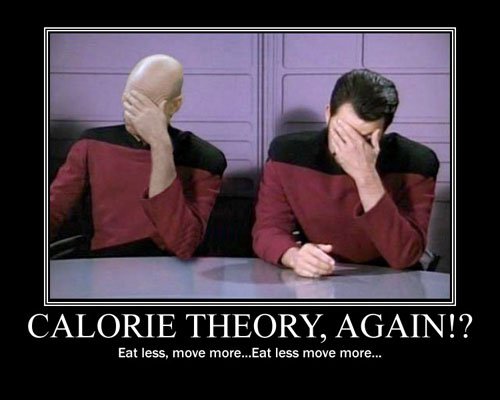
I love the above graphic from Steve at Diet for Humans, who also writes:
Calorie theory is simply wrong, but it just appears to be correct if one has limited experience or a limited frame of reference.
I don’t think this means that calories don’t matter at all, but IMO, for many of us, the real issue is what’s going on to drive appetite in excess of our needs. Hormones, as Steve suggests, certainly play a part, but there are others as well (e.g., micro-nutrients and neurotransmitters).









“…the real issue is what’s going on to drive appetite in excess of our needs.”
I agree. I understand that “needs” and “appetite” are social constructions, which makes them as real as other socially constructed needs, such as the “need to earn a living.” Sometimes, however, we may encounter the surprising opportunity to deconstruct reality, to choose a contrary experience with former ways of participating with reality. Then, for example, what was for most of my life what I experienced as excess appetite or excess hunger (or craving) became transformed as a different human need altogether. For now, the closest description I can use is contained in the concept of solidarity. This is not offered as some kind of suggestion for others to follow, or as testimony of efficacy or universality; merely a sharing of my own experience with deconstructive transformation through solidarity. Some might call it “the power of negative thought”. For me it started, but by no means ended, with questioning the validity and truthfulness of nearly everything I had been taught about human hunger, appetite, nutrition, etc. (Including “calories” and what they supposedly measure, as well as the concept of “dieting”, and what that reveals about human consciousness.) This continues to be a great adventure.
Curious! I was actually thinking more of “needs” and “appetite” as physiology, not so much social construct! I.e., why is it that leptin doesn’t appear to turn off the desire to eat in some of us since that’s what it’s supposed to do?
But either way, yes, it’s certainly a great adventure. But it’s also (IMO) critical public health policy. I’m very concerned that it is going to get a lot worse for obese people before it gets better.
I have encountered a strange situation. My mother has short-term memory loss. Sometimes 30 minutes or so after we have eaten, she will ask whether or not we have eaten or when will we be eating. At first I was surprised because I thought her body would remember eating. At times, she does say that she’s hungry. I usually give her a snack or another small meal. She has a small appetite and doesn’t eat a lot at meals, so she will eat again without becoming overly full. I believe that her asking derives from the expectation of routine, as she knows that we eat lunch or supper at a certain time. Perhaps my mother’s situation could be called social conditioning?
Do you follow J Stanton? His post yesterday, “Why Are We Hungry? points out that real satiety takes a few hours in terms of digestion.
But I think you’re right, given that she doesn’t eat a lot, her body certainly isn’t giving her other cues (like sense of fullness). And of course, it’s common for people to out of practice when it comes to eating when hungry, as our culture really promotes the opposite!