Last week, Jimmy Moore had this to say about the paleo diet in his Diane Sanfilippo podcast post (emphasis mine):
[L]ast night there was a feature story on ABC’s “Nightline” on the Paleo movement with people like Robb Wolf and Art De Vany sharing what it means to implement the Paleo lifestyle change nutritionally and physically. WAY COOL exposure for this subset of low-carb living that I sense will only continue to grow and grow in the years to come.
Now, my undergraduate degree is in math (and I like to quibble), so I had an issue with the term “subset” (as you can see from the comment discussion I had with Jimmy).
Introducing my diet comparison chart
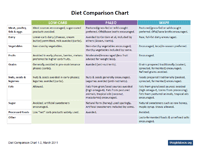 This interchange prompted me to do something that I’ve been meaning to do for a while: compare and contrast the basic tenets of low-carb, paleo, and Weston Price diets (all three of which are, in my opinion, vast improvements over the standard American diet).
Click on the image at right or this diet comparison link to download a PDF of my first pass. I welcome your comments to improve it.
Caveats: This is a one-pager, not a thesis. I wanted to create a simple overview, not address all the intricacies of the three diets.
I used these as primary resources (low-carb, paleo, WAPF), but also referred to others.
So take a look and see what you think. Let me know what’s good, bad, or indifferent in the comments below or via email. Thanks!!
 Weight Maven is written by Beth Mazur. Beth believes that obesity is more symptom than cause and that the real problem is our Western diet -- especially sugar, refined grains, and industrial oils. Beth writes about nutrition, ancestral health, & food policy. And cats!


Nice comparison! What about net carbs and fiber from all sources encouraged/discouraged? I know it isn’t really a concern with WAPF, but I know low carb and to a degree the paleo comments on fiber.
I don’t know if that really is worth mentioning or not.
This is genius. I find legumes a curious one and starchy vegetables. I blogged grass-fed beef today, yum.
add Foodtrainers to blog roll :) I need to add Weight Maven.
What about adding on the omit side:
Fast Food
Candy
And I also agree with your “About Me” thoughts. We have a food dilemma that feeds the obesity epidemic and ultimately the disease care system.
It might get too complicated, but you may want to add a row entitled something like “Focus.” Low-carbers focus on weight loss and weight control; paleo and WAPF focus on health.
Regarding low-carb, it’s hard to say that artificial sweeteners and processed low-carb items are encouraged. You’re right that they are generally allowed, whereas they are shunned by most paleos and WAPFers. In contrast to the last low-carb fad that ended in 2003, current low-carbers are less likely to use artificial and processed foods.
-Steve
Great chart. For us long-term low carbers, this allows one to check each box and find out our particular tendency.
Me - I appear to straddle low carb and paleo. While I have great admiration for the Weston Price foundation, it’s a little to extreme for me.
I think the bone broth/ferment/organ meats thing is new to paleo, coming from WAPF. To me, low carb is about weight loss, paleo is about LGN and performance-related health, and WAPF is about long-term, reproductive-supporting health.
I’ve seen you comment around the blogs, but never tracked you down - will enoy reading through the archive this w/end!
Hi,
Just discovered you looking for exactly this sort of comparison!
The chart is very helpful, but can you explain the “anti-nutrient” note on some things?
Anti-nutrients are those things in foods that diet proponents encourage followers to avoid because they aren’t healthful. Anti-nutrients in grain, for example, are phytic acid (which bind to the minerals in the grain preventing them from being absorbed) and proteins like those in gluten that are thought to be the primary cause of immune problems as a result of leaky gut syndrome.
That’s a great comparison. I’ve been looking into these diets, and it’s nice seeing the imformation in a chart.
Thanks!
What a nice job. Women are such great organizers/communicators!
[Don't mind me, I'm old.]
Like this chart!