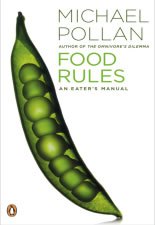
 Prompted by Michael Pollan’s appearance on The Daily Show on Monday, I finally picked up the copy of Food Rules that I’d ordered right after the New Year (thank you Amazon Prime!).
Pollan’s website describes the book this way:
Eating doesn’t have to be so complicated. In this age of ever-more elaborate diets and conflicting health advice, Food Rules brings a welcome simplicity to our daily decisions about food. … [T]his indispensable handbook lays out a set of straightforward, memorable rules for eating wisely, one per page accompanied by a concise explanation.
It’s a very quick little read (on The Daily Show, Jon Stewart commented that he enjoys “any book that was fun sized”), since each rule is delivered one per page, sometimes with little to no accompanying text.
After all, how much explanation do you need for rule 20?
It’s not food if it arrived through the window of your car.
I found the intro of the book to be the most interesting. Pollan points out:
- Nutrition science is relatively young. At 200 years, it is where surgery was in 1650.
- The focus in nutrition research is driven by the food and pharma industries. If they can find “the” villain, they can modify food to sell us and/or drugs to act as an antidote.
- Confusion about what to eat is good business (see note re food and pharma industries above).
But Pollan also points out that amidst all the confusion there are two (or three) facts that everyone seems to agree upon.
First, the Western (or Standard American) diet is strongly linked to chronic disease:
Populations that eat a so-called Western diet-generally defined as a diet consisting of lots of processed foods and meat, lots of added fat and sugar, lots of refined grains, lots of everything except vegetables, fruits, and whole grains-invariably suffer from high rates of the so-called Western diseases: obesity, type 2 diabetes, cardiovascular disease, and cancer. … The arguments in nutritional science are not about this well-established link; rather, they are all about identifying the culprit nutrient.
Second, a wide range of traditional diets don’t present this same link:
Populations eating a remarkably wide range of traditional diets generally don’t suffer from these same diseases. These diets fun the gamut from ones very high in fat (the Inuit in Greenland subsist largely on seal blubber) to ones high in carbohydrates (Central American Indians subsist largely on maize and beans) to ones very high in protein (Masai tribesman in Africa subsist chiefly on cattle blood, meat and milk) to cite three rather extreme examples. …
Pollan notes that populations following other, less extreme diets also lack the link to chronic disease. He writes (emphasis mine):
What this suggests is that there is no single ideal human diet but that the human omnivore is exquisitely adapted to a wide range of different foods and a variety of different diets. Except, that is, for one: the relatively new (in evolutionary terms) Western diet that most of us are now eating.
What an extraordinary achievement for a civilization: to have developed the one diet that reliably makes people sick!
The third fact flows from the first two: “People who get off the Western diet see dramatic improvements in their health.”
Aye, there’s the rub! Eating a non-Western diet in a Western culture can be a bit of a Sisyphean task. It leads some to think policy (cue Jon Stewart: “how do you legislate deliciousness?”).
But that’s not the focus of Food Rules. The rest of the book presents Pollan’s 64 rules — or “personal policies” — that are meant to help guide everyday decision making about what to eat. The rules are organized into three categories that flow from the one overarching principle from his previous work:
Eat food. Mostly plants. Not too much.
As it turns out, coming up with 64 different ways to say “eat food, mostly plants, not too much” means you necessarily wind up repeating a bit. Pollan notes that the intention is for a handful to register and stick with people as they shop and prepare food.
I have a bit of a bias. I like it when Pollan talks about food policy (and the problems with what Pollan calls “edible foodlike substances”). So I found the first section the most interesting, like rule 2:
Don’t eat anything your great-grandmother wouldn’t recognize as food.
Pollan makes the same observation that Kessler has in The End of Overeating: that industrial food today has been “specifically designed to get us to buy and eat more by pushing our evolutionary buttons-our inborn preferences for sweetness and fat and salt.”
The book is fairly simple. You can see the type of rules Pollan included by checking out 20 of his favorite rules provided by NY Times readers.
Me, I found the last section a bit old (e.g., eat slowly, use smaller plates, skip seconds), but it certainly fits his framework. And of course, hard-core paleo or low-carb folks won’t like part 2, which promotes lots of veggies and downplays meat. And people who care more about the policy aspect of this would probably prefer Pollan’s In Defense of Food.
All in all though, Food Rules is a great read for people who are troubled by all the confusing nutritional advice they are getting from different sources. The bottom line is the more people eat real food, the better!
 Weight Maven is written by Beth Mazur. Beth believes that obesity is more symptom than cause and that the real problem is our modern culture -- especially diet. Beth writes about ancestral health, health policy, & mindfulness. And cats!


What do you think? (Comments from Weight Maven first-timers are moderated.)