Managed to get caught up on my feed reading. One thing I liked: FredT’s idea to avoid sugar, grains, omega 6s, and adopt a “honey badger attitude” (see below).
Unfamiliar with the honey badger? Here’s a primer:
Posted in Brain & appetite, Weight loss on July 29, 2011 | 2 Comments »
Managed to get caught up on my feed reading. One thing I liked: FredT’s idea to avoid sugar, grains, omega 6s, and adopt a “honey badger attitude” (see below).
Unfamiliar with the honey badger? Here’s a primer:
Posted in Real food, Visual on July 29, 2011 | Leave a Comment »

Sorry for the light blogging, but between studying for my nutrition mid-term (passed yay!), spending some time at the beach (OBX) and heading off to the Ancestral Health Symposium in a bit, it’ll be another week or so before I can get back on track.
In the meantime, check out this great take on the USDA’s “Food Plate” from Adam Fields (HT Stephan Guyenet) and Kris’ blog, where he’s starting a series on junk food addiction.
Posted in Friday cat blogging on July 22, 2011 | 3 Comments »
Posted in Me, me, me on July 19, 2011 | 2 Comments »
Did well on my nutrition mid-term (phew!). Am once again entertaining the thought of more school … maybe even a horrible, irrevocable life choice ;).
Posted in Macronutrients, Visual, Weight loss on July 16, 2011 | 4 Comments »
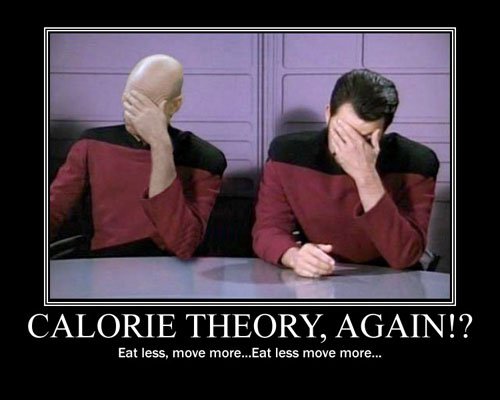
I love the above graphic from Steve at Diet for Humans, who also writes:
Calorie theory is simply wrong, but it just appears to be correct if one has limited experience or a limited frame of reference.
I don’t think this means that calories don’t matter at all, but IMO, for many of us, the real issue is what’s going on to drive appetite in excess of our needs. Hormones, as Steve suggests, certainly play a part, but there are others as well (e.g., micro-nutrients and neurotransmitters).
Posted in Friday cat blogging on July 15, 2011 | 2 Comments »
Posted in Brain & appetite on July 13, 2011 | Leave a Comment »
Interesting juxtaposition of blog posts today. First, over on the S.P.E.E.D blog, they speculate that folks pushing weight loss are missing the big picture, and that the answer is “dieting psychology goodness”:
When I coach someone for the first time I ask “If you were going to design a diet for yourself, or change your current diet, what would you do?” I almost always get great ideas in response. “Eat more fruits and vegetables.” “Eat more protein.” “Get some healthy fats.” “Control my portions.” Sometimes I have to nitpick a little, but most of the time the answers are pretty right on the money.
The next question I ask is “On a scale from 1 to 10, how confident are you that you can achieve your goals and maintain them long-term? 1 being not-at-all and 10 being absolutely sure.” The number of answers I get below 5 is astounding. I don’t care if you have Gary Taubes or T. Colin Campbell as your personal dietician and Tony Horton as your fitness consultant, if you don’t think you can do it you can’t.
My follow-up question is that of a 5-year-old: “Why?” The answer? “I don’t know. I mean, I know what I should do and I start out good for a few days, but then I just fall off.” This is a matter of the mind and this is what sets apart the successful dieters from the failing dieters. Maybe we should make P the only capital letter in sPeed.
Meanwile, over on gnolls.org, J. Stanton kicks off a promising series: Why Are We Hungry?:
It is the 21st century. We have telephones that fit in a watch pocket, we can sequence the genetic code of life itself, and we can sift the accumulated knowledge of centuries in fractions of a second using Internet search engines. Yet we still don’t understand enough about human biochemistry to create a pill that stops us from eating without causing heart valve defects or uncontrollable diarrhea. …
Hunger is the interaction of several different clinically measurable, provably distinct biochemical processes—each with its own effects on our brains and bodies. Until we understand this, we are doomed to confusion: fragmentary understanding and incomplete solutions that address only one component of hunger while ignoring the others.
Fortunately, we don’t have to understand the biochemical cascades involved in liking, wanting, satiation, and satiety—because no one does. (These are “active research areas”, which means “we’re still trying to figure all this stuff out”.) Simply understanding these drives on a conceptual level—and why they were selected for in our evolution as humans—can help us navigate the dangerous shoals of dietary advice.
I’m with J. Stanton. I think the answer is far more likely to be found in physiology than in psychology. I’m looking forward to his future posts!
 Weight Maven is written by Beth Mazur. Beth believes that obesity is more symptom than cause and that the real problem is our modern culture -- especially diet. Beth writes about ancestral health, health policy, & mindfulness. And cats! More »


