 Today is Blog Action Day and this year’s topic is food, so I thought I’d play along with a post on a subject near and dear to my heart: food, appetite, and overeating.
Part of what makes this timely is Peter’s post over at HyperLipid on mitochondrial damage and obesity, as well as the followup discussion on PaleoHacks.
I can understand having issues with Stephan Guyenet’s food reward hypothesis; I myself am skeptical about some of the implications (which may or may not be correct, given how Stephan has been trickling out the info).
But what I cannot understand is some folks’ apparent certainty that reward plays little to no part in obesity.
I grant that I am not a research scientist nor a medical clinician. I think I have half a clue (was pre-med in college and graduated with a degree in math and a minor in physics), but more importantly (to me anyways), I have multiple decades of having struggled with obesity and overeating.
So I have no real stake in the intellectual pissing match re whether this is food reward, the carb-insulin hypothesis, or something else entirely. As J Stanton says, “I am neither selling diet books nor defending a career-building hypothesis.” Nope, unlike those for whom this is primarily an academic discussion, I’m in this to resolve my obesity & overeating after DECADES of trying.
Real people, real problems
This comment over at Refuse to Regain nearly broke my heart (this was me a year ago):
I am 65 years old. I have fought with my weight for 35 years. … I have lost 100 pounds three different times and gained it back. I now weigh 330 pounds. I have started another diet again, eating healthy and exercising. I feel like I will die if I don’t find the way to lose this weight and keep it off. I do real good as long as I count calories and stay mindful of my eating. But then I want sweets and fried foods and one time is not enough, I want more and more and then I just don’t worry about the weight until someone looks at me with disgust, or I can’t walk for long, shopping. Then I get scared and start eating healthy and walking more and riding my exercise bike. I have let my life slip away without experiencing the things I wanted to experience, like riding horse, swimming, going to concerts, can’t sit in the chairs, going to the opera, dressing up and going places with my husband. I want this and I go after it with all my heart and then something happens and I forget what my goals are and I am off on a binge. It like I get amnesia, wake up and can’t believe I have done this before. I wish you had an answer for me before I die.
I suppose this could be just about mitochondrial dysfunction, but I think there’s something more … and I think that it has a LOT to do with the brain, food reward, and what Stephan calls “professionally designed industrial food.”
Now, I’ll grant that Pat and I are outliers, and I also grant that obesity existed long before the industrial food revolution (hell, I had my first weight loss visit to the docs in the 60s). And sure, the average overweight person does not have this kind of issue with food. But I do think we’re an endpoint on a continuum and I think our modern food environment is like the 60s on steroids (and interestingly, lots of folks seem to do well when these foods are removed … food reward, mitochondria, or both?).
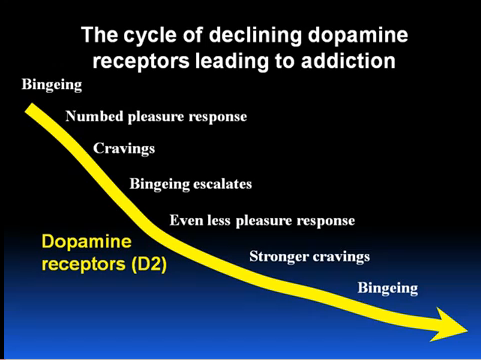
This chart from Your Brain on Porn illustrates the continuum that resonates with me re food and overeating:
[Side note: I also had an "a ha" after watching Bart Hoebel's presentation Sugar Addiction: Bingeing, Withdrawal and Craving. The best way to develop binge eating in rats? Give them sugar and then deprive them of it. Makes me wonder if I would have had the overeating issues I had if I hadn't been on so many diets.]
Now, if you avoid getting hung up by the fact that “food addiction” is a terrible label (it’s not “food” that is likely the problem … but ingredients in food that we never adapted to eat in the quantities typical in modern processed food like sugar, salt, refined wheat and veggie oils), does it not seem plausible that some/part of cause of obesity is persistent overfeeding as a result of appetite dysregulation due to high calorie, low nutrient Western food?
All eating, all the time
In the same post at Refuse to Regain, Alexie makes a really insightful comment:
One thing I think we’ve missed in all the discussions is the collapse of social rules around eating. We have, in the last twenty years, abandoned thousands of years of food culture. There have only been very specific instances in history where it was OK to eat on the run, or eat publicly while walking down the street etc, or skip communal meals. Yet now we seem to see meals served on a table, with the family all present, as an unaffordable luxury. I wonder how many problems with food would simply vanish if regular, ordered eating became normative again. If eating cake is only done at socially sanctioned times and in socially sanctioned ways (the Sunday visit), then cake ceases to be a problem. Once cake becomes something you can eat at any time of the day or night, you’re going to have to expend precious mental energy consciously limiting your exposure to cake.
Again, from Your Brain on Porn, there seems to be a plausible evolutionary mechanism for overriding appetite … you feast to avoid the inevitable famine:
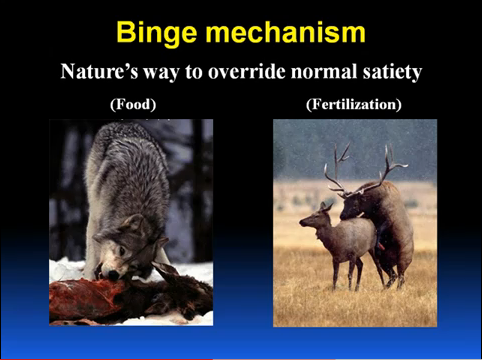
To me, this says food reward. It’s a mechanism that was protective and desirable in the paleolithic, but perhaps not so helpful in a world of 24-hour Wal-Marts and cake you can eat at any time of the day or night.
Eat to live, live to eat?
To be fair to Wal-Mart (and the rest of the food industry complex), they are selling us what we want to buy.
A while back, Kurt Harris wrote this comment on Whole Health Source:
People in our culture of continuous serial entertainment hate the idea that food be demoted from entertainment to the moderate pleasure of satisfaction of hunger and refueling….
They LIKE thinking about food all the time.
Food reward theory is really a much more deeply subversive idea idea than either carbohydrate or fat as the black monolith of obesity and disease.
I agree. So mitochondrial folks, by all means wax poetic on the subject (though at least one blogger thinks that idea is one big trial balloon). You may not believe it from this post, but I am open to being convinced that food reward is not an issue, or is secondary to some other issue.
In the meantime, I think that minimizing industrial food — or at the very least, practicing “intelligent control” of hyper-palatable foods — makes lots of sense.
Bombarded by food cues
Actually, I think it makes more than lots of sense, I think it’s critical. One of the problems I have with Stephan’s theory is that I doubt that the long-term compliance rate for a bland food diet (the endpoint of Stephan’s recommendations) is going to be any better than that of any other restrictive diet.
As Yale’s Ashley Gearhardt says (around the 21:00 mark in the video above):
The role of cues is especially important … think about the amount of floods of advertisements and food cues that you saw today. Just imagine, shifting in your head, thinking if those were all alcohol cues and you were someone who was struggling to control your alcohol use. That’s going to be a really difficult challenge. The role of cues, potentially dealing with the cues in our environment, is an especially important area to look at in the future.
People may “like” thinking about food all the time, but that may well be because they are being bombarded by food cues 24×7.
So I suspect that what Tim Ferris’ slow carb diet has going for it is a way to provide that intelligent control. I don’t like the cheat day concept as described in 4HB (which most people interpret as binge day), but I have been making a similar concept work for me since January: I follow PHD, but once a week, I eat what I want. Makes it easy for this to be a lifestyle, not a temporary restrictive diet.
No, it’s not ideal, but it’s been a useful crutch for me. It will be interesting to see how I evolve with this (and I’m waiting with, say it — ANTICIPATION — for more from J Stanton on why we are hungry).
For now, I’m grateful to no longer be suffering from the overeating rollercoaster. Thank you real food!
Update, 10/16: What Mike at Fat Fiction said:
A food manufacturer’s job is to maximise profit, and while it’s all very well to appeal to their common decency to produce food stuffs that won’t turn us into oompa loompas, the reality is it’s one of the most competitive and cutthroat industries in the world. When consumer demand cheap products, bulking up with processed grains and seed oil is the most sensible strategy. When consumers demand taste, adding sugar is the simplest way of meeting their needs. When consumers demand health – well that’s when change happens.
 Weight Maven is written by Beth Mazur. Beth believes that obesity is more symptom than cause and that the real problem is our Western diet -- especially sugar, refined grains, and industrial oils. Beth writes about nutrition, ancestral health, & food policy. And cats!


If one looks at black and white photos of factory workers all lined up on risers for a company photo in the 30s, 40s, 50s, there are few it any obese or fat people among the workers. They all ate real food. It would not appear that there was a pervasiveness of metabolic syndrome among these folks. No leaky guts, no obesity, little diabetes. etc.
But look at the photos from the 60s forward. Lots of heavier folks. Correspond to the coming genetically engineered dwarf wheat products of Dr Davis? Correspond to the pervasiveness of Omega 6 FA in diet? The low fat industry was in its infancy and Ancel Keys was gaining relevance among our politicians.
We are not eating the same foods as our parents and grandparents ate during the first half of the last century. The meat was mostly grass fed animals, the milk was full fat raw whole milk,butter was full fat grass fed milk butter. The veggies were not laden with pesticides. No concentrated bovine feeding operations using soybeans, corn, or wheat as the main sustenance.
I am old enough to remember a two pound brick of hydrogenated fat that came with a yellowing packet that we massaged into the fat to make it look like butter. It wasn’t real food…of course. Margarine.
I remember both my mother and father being slim and strong in the fifties and then I watched them put on weight year after year. In retrospect, it was their eating of packaged convenient foods.
Mitochondrial dysfunction brought about by neolithic foods? Yup and the advent of the avoidance of arterycloggingsaturatedfat. My parents never gave a thought to saturated fat as being healthy or unhealthy. It was what was and they were thin and happy.
I am with you that this is related to neolithic foods (even if that means going back to the 17th century re refined sugar). I just am not there yet with the whole mitochondrial dysfunction thing yet.
I am stunned by the writings of various doctors, dieticians & nutritionists who still push the meaningless mantra of “Everything’s okay in moderation!” — when no one can define what “moderation” means. If I currently eat fast food 7 days a week and I reduce it to 4 days a week, is that moderation? If I eat a big sugary muffin from the bake shop once a day but no other “sweets,” is that “moderation”? And I actually read a blog from, I believe, an RD yesterday who was defending her practice (and encouraging others) of giving junk food to her toddler “occasionally” — not sure how often or what “foods” exactly (because they’re gonna learn about it somewhere, might as well be at home! was the logic)…knowing, full well, I assume, that once those chemicals and additives and HFCS and MARKETING establish a presence in the child’s mind and body, the cycle of craving begins? Why, if the child knows there are cupcakes in the house, is he or she going to ask for oatmeal or a lettuce wrap?
Awful, awful. My sympathies to the 65 year old Refuse to Regain commentor. As you said, her words are heartbreaking. From my own weight issues experience, I’d say she has an eating disorder and would benefit from cognitive therapy.
Now that I can better manage my own psychological barriers to weight loss, I’m favouring healthy foods over junk food, a salad is more satisfying than processed foods and fruit is healthy and sweet.
You crave what you eat. But, no matter what you eat you have to eat happily and not dwell on the food you are not eating….
I’m not sure these are competing theories. It seems more likely to me that they are different links on the causal chain.
If you say that excess carbohydrate consumption causes obesity, it begs the question “What causes excess carbohydrate consumption?”
I think that’s where food-reward comes in: Refined carbohydrates made “hyperpalatable” by the addition of fat and or salt, and God knows what else.
Like you, I’m not sure where mitochondrial dysfunction fits in.